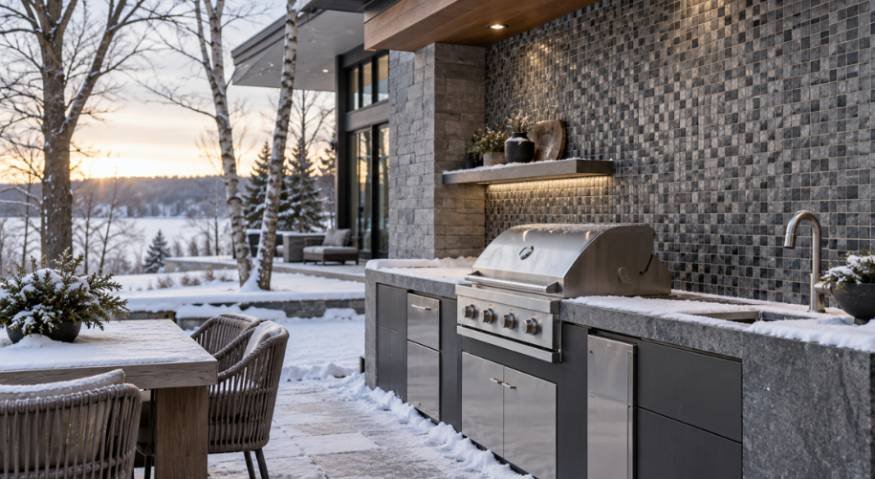
Last winter, a client called me out to inspect an outdoor kitchen backsplash in upstate New York that had completely sheared off after a single January blizzard. The homeowner purchased gorgeous ceramic sheets marketed as “outdoor-safe,” but the first sustained freeze popped forty percent of the tiles off the concrete backer board.
Selecting true freeze thaw resistant exterior mosaic tiles for cold climates requires separating decorative sales claims from structural physics. When sub-zero temperatures hit, moisture trapped inside or behind your tile assembly expands by roughly nine percent. That volumetric growth creates immense hydraulic pressure. Without impervious materials and flawless assembly, your exterior tile work will crack, pop, and delaminate before spring.
[ WATER INTRUSION PATHWAY ]
│
▼
┌──────────────────────────────┐
│ Porous Grout / Micro-Gap │
└──────────────┬───────────────┘
▼
┌────────────────────────────────────────┐
│ Trapped Moisture Behind Tile │
│ (Voids in Mortar / Absorbing Body) │
└───────────────────┬────────────────────┘
▼
┌────────────────────────────────────────┐
│ Freezing Temp (< 32°F / 0°C) │
│ 9% Volumetric Expansion Generates │
│ Up to 30,000 PSI Pressure │
└───────────────────┬────────────────────┘
▼
┌────────────────────────────────────────┐
│ BOND FAILURE, DELAMINATION & CRACKS │
└────────────────────────────────────────┘
The Physics of Frost: Why Standard Mosaics Fail Below Freezing
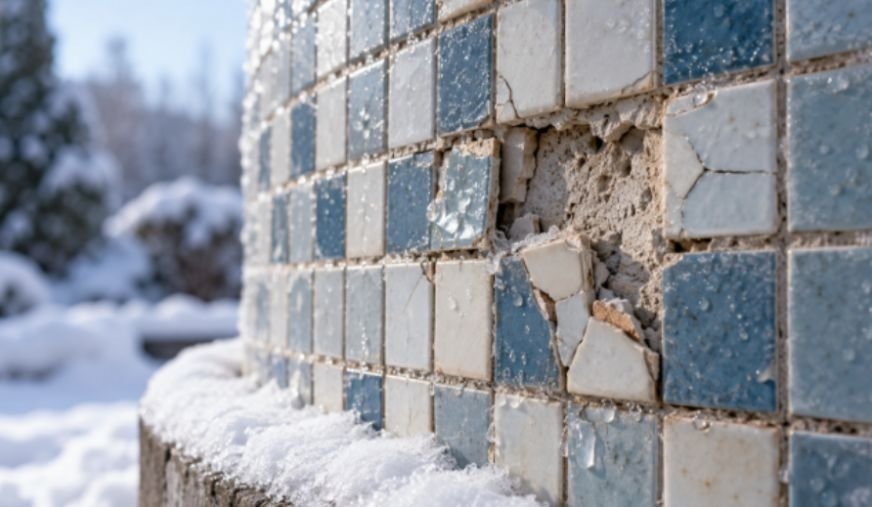
Water expands with incredible force when it transitions from liquid to solid. When moisture penetrates a porous tile body or settles into a hairline gap behind the installation, freezing temperatures turn that water into an expanding mechanical wedge. Over successive freeze-thaw cycles, micro-fractures propagate until the glaze spalls off or the entire tile shears from its setting bed.
The 0.5% Water Absorption Threshold
To survive harsh winters, exterior mosaics must belong to the impervious class. This requires an absolute water absorption rate of less than 0.5 percent by weight, determined under strict boiling test procedures.
Porous tiles act like sponges. In autumn, driving rain saturates open capillaries inside low-fire ceramics or porous stones. When the thermometer plunges overnight, that internal water expands, fracturing the internal matrix of the tile. Standard wall ceramics often carry absorption rates exceeding 7 percent, making them catastrophic candidates for northern regions.
The Sub-Zero Cavity Failure Principle
My field teardowns reveal that tile failure rarely starts with the face of the mosaic itself. Instead, it stems from the Sub-Zero Cavity Failure Principle. When an installer leaves an air void behind an impervious tile, dew-point condensation and perimeter moisture migrate into that pocket.
Water trapped inside an enclosed cavity can exert up to 30,000 pounds per square inch of hydraulic pressure as it freezes. Because an impervious porcelain or glass mosaic will not allow the ice to expand outward through its surface, that internal force pushes outward against the mortar bond. The result is instantaneous bond destruction, regardless of how frost-proof the tile surface claims to be.
Evaluating Tile Materials for Sub-Zero Cladding
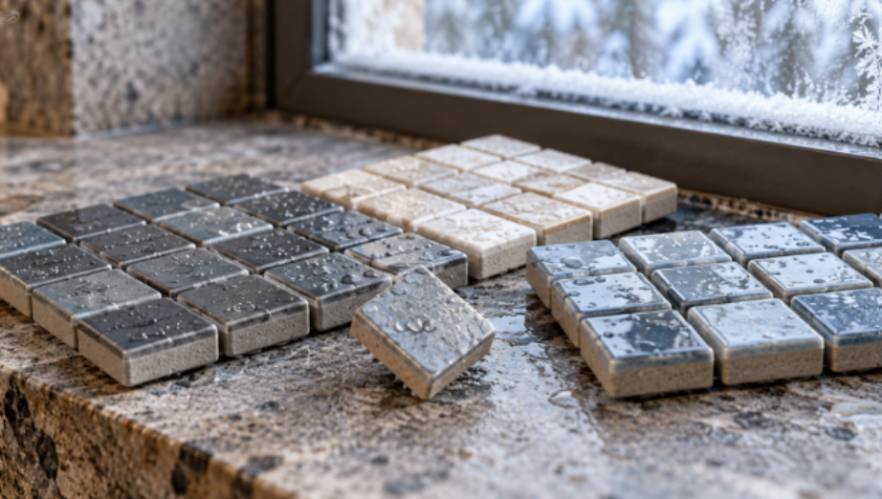
Never rely on generic product tags that simply say “exterior rated.” You must evaluate the base raw materials, density, and firing methods to guarantee durability.
+──────────────────────────+───────────────────+──────────────────────+──────────────────────────+
| Material Class | Water Absorption | Thermal Stability | Cold Climate Suitability |
+──────────────────────────+───────────────────+──────────────────────+──────────────────────────+
| Vitrified Porcelain | < 0.5% | Excellent | Superior (Recommended) |
| Fused / Cast Glass | 0.0% | High (Check Stress) | Superior (Pools/Accents) |
| Natural Slate / Travertine| 1.0% – 5.0%+ | Poor (Foliated) | Severe Spalling Risk |
| Standard Glazed Ceramic | 3.0% – 10.0%+ | Poor | Guaranteed Failure |
+──────────────────────────+───────────────────+──────────────────────+──────────────────────────+
Fully Vitrified Porcelain Mosaics
Fully vitrified porcelain remains the undisputed workhorse for extreme seasonal swings. Manufacturers blend fine kaolin clays, feldspar, and quartz, pressing them under extreme hydraulic pressure before firing at temperatures exceeding 2,200 degrees Fahrenheit.
This vitrification process fuses the ingredients into a dense, glass-like composite that limits moisture absorption to virtually zero. Glazed porcelain mosaics designed for cold regions provide deep texture variations mimicking stone, yet they resist frost cracking, de-icing salts, and direct UV discoloration throughout decades of sub-zero exposure.
Fused and Cast Glass Mosaics
High-grade architectural glass mosaics are inherently non-porous with an absolute water absorption rate of zero percent. Moisture cannot penetrate the surface of fused or cast glass, eliminating internal ice expansion entirely.
Glass tiles excel around outdoor waterlines, modern porch elevations, and courtyard accent walls. However, glass expands and contracts at twice the rate of porcelain under rapid temperature swings. You must source annealed glass tested for thermal shock to avoid thermal stress fractures during quick temperature drops.
Glass tiles also work well in water-exposed outdoor spaces where material selection and moisture management are essential. For design inspiration, explore these outdoor shower mosaic tile design ideas for incorporating decorative glass and mosaic finishes into an exterior shower area.
Materials to Exclude from Northern Facades
Leave standard ceramics, unsealed terracotta, and soft natural stones out of your exterior plans. Terracotta and standard glazed wall tiles feature porous clay bodies that saturate quickly in fall rain.
Avoid porous natural stones like travertine, split-face marble, and unsealed sedimentary slate. Slate splits along natural cleavage lines when moisture penetrates its layers and freezes. Travertine contains natural voids that collect standing moisture, leading to face-spalling within one or two cold seasons.
Building a Weatherproof Mosaic Tile Accent Wall That Survives Winter
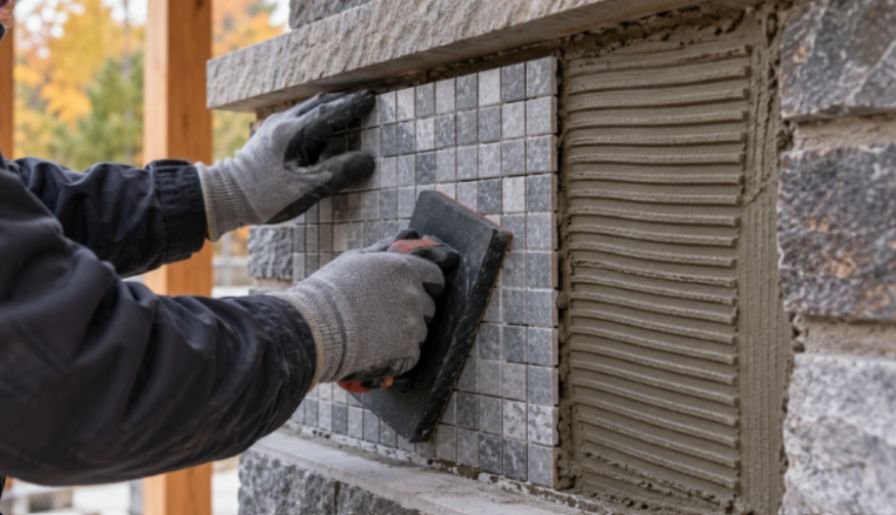
Selecting an impervious tile solves only half of the cold-climate equation. The surrounding installation system must handle freezing moisture, structural movement, and thermal contraction.
For a practical example of applying these weatherproofing principles to a residential entrance, see this guide to creating a weatherproof mosaic tile accent wall for front porch, with design considerations for an exterior feature that must withstand the elements.
[ OUTDOOR ASSEMBLY CROSS-SECTION ]
================================================== < Surface (Mosaic)
————————————————– < Waterproof Epoxy Grout
================================================== < 100% C2-S1 Mortar Bed
————————————————– < Uncoupling Membrane
~~~~~~~~~~~~~~~~~~~~~~~~~~~~~~~~~~~~~~~~~~~~~~~~~~ < High-Bond Liquid Waterproofing
================================================== < Solid Masonry / Concrete Substrate
Substrate Stability and Uncoupling Integration
Exterior tiles must sit on dimensionally stable, non-rotting backing materials. Poured concrete, concrete masonry units (CMU), or high-density exterior cement boards form the only acceptable bases. Never apply exterior mosaics over exterior-grade plywood or standard drywall, even under covered porches.
Freeze cycles cause outdoor walls to expand and contract dramatically. To safeguard your assembly, look into the proper techniques for choosing exterior uncoupling membranes. Geometric uncoupling mats create an engineered shear plane between your home’s framing and the mosaic finish.
When the substrate shifts during deep freezes, the uncoupling layer absorbs that lateral movement, preventing stress cracks from migrating up through delicate mosaic joints. Follow the movement joint specifications outlined by the Tile Council of North America to provide perimeter relief every eight to twelve feet.
Achieving 100% Mortar Transfer with C2 Polymer Adhesives
Standard interior dry-set thinsets snap under thermal tension. For cold climates, specify a high-performance polymer-modified mortar meeting ISO 12004 Class C2-S1 or C2-S2 specifications. The “C2” rating indicates superior bond strength, while the “S” rating denotes lateral flexibility under seasonal thermal strain.
For a reliable installation on masonry surfaces, follow this guide on how to install mosaic tiles on an outdoor concrete wall to understand the surface preparation, mortar application, and coverage techniques needed for a durable exterior finish.
+───────────────────────────────────────────────────────────────+
| CRITICAL MORTAR SPECIFICATION |
| |
| – Standard Troweling: 80% coverage (Yields trapped air voids)|
| – Sub-Zero Requirement: 100% full-bed coverage |
| – Application Method: Flat-back trowel wall + Flat-trowel |
| mosaic sheet back (Back-buttering) |
| – Result: Zero air pockets = Zero trapped water expansion |
+───────────────────────────────────────────────────────────────+
When setting sheets, collapse every single trowel ridge using a firm rubber beating block. Air channels beneath your tile act as catch basins for condensation. In freezing weather, full mortar coverage is your primary structural insurance policy.
Grout Selection: Why Cementitious Joints Fail
Standard cement grout relies on a porous micro-structure that readily drinks water. Once saturated, cement joints freeze, crumble to powder, and permit moisture to run directly into your mortar bed.
Protect your exterior installations with high-performance epoxy grout formulations. True epoxy grouts are two-part resin compounds that cure into an impenetrable, non-porous polymer barrier. They block moisture migration completely, resist road salt corrosion, and will not crack when winter winds whip across your facade.
Critical Lab Certifications to Demand from Manufacturers
Before ordering materials for an outdoor project, look past marketing brochures and request the technical product data sheet. Verify the following independent laboratory testing certifications:
- ASTM C1026: Standard Test Method for Measuring the Resistance of Ceramic Tile to Freeze-Thaw Cycling, administered by ASTM International. This test subjects tiles to repeated freezing and thawing cycles submerged in water to confirm zero splitting, cracking, or spalling.
- ISO 10545-12: The global freeze-thaw durability standard confirming zero surface destruction after a minimum of 100 consecutive freeze-thaw cycles.
- ANSI A137.1 / ANSI A137.2: Look for the mandatory dimensional stability, bond strength, and thermal shock resistance criteria established for porcelain and glass mosaic tiles.
- Thermal Movement Compliance: Cladding assemblies must adhere to expansion joint detailing outlined by the International Masonry Institute to handle freeze-thaw stresses safely.
Frequently Asked Questions
1. What is the maximum water absorption rate allowed for freeze-thaw exterior mosaics?
Cold-climate exterior mosaic tiles must carry a water absorption rate under 0.5 percent to prevent internal moisture expansion and frost spalling.
2. Can I install glass mosaic tiles on an outdoor patio wall in sub-zero zones?
Yes, as long as the glass is fully annealed, thermal-shock tested, and installed with a flexible polymer mortar and non-porous epoxy grout.
3. Why do mosaic tiles fall off exterior walls after the first winter?
Mosaics detach when moisture penetrates porous grout or uncollapsed mortar voids behind the tile, creating expanding ice pockets that destroy the adhesive bond.
4. How do I prevent an outdoor mosaic accent wall from cracking during freeze cycles?
Incorporate perimeter movement joints every eight to twelve feet and install an exterior uncoupling membrane to decouple the tile from substrate movement.
Frost-Proof Your Walls Before the First Freeze
Freezing winters show zero mercy to rushed tile installations or porous materials. If you cut corners on water absorption ratings or settle for basic cement grout, sub-zero temperatures will destroy your accent wall within months.
Source certified impervious porcelain or thermal-shock-tested glass. Demand strict compliance with ASTM C1026 standards, butter every mosaic sheet to achieve true 100 percent mortar coverage, and seal the entire matrix with two-part epoxy grout.
Build your exterior assemblies to resist hydraulic ice pressure, and your mosaic accents will stand pristine through decades of relentless winter storms.