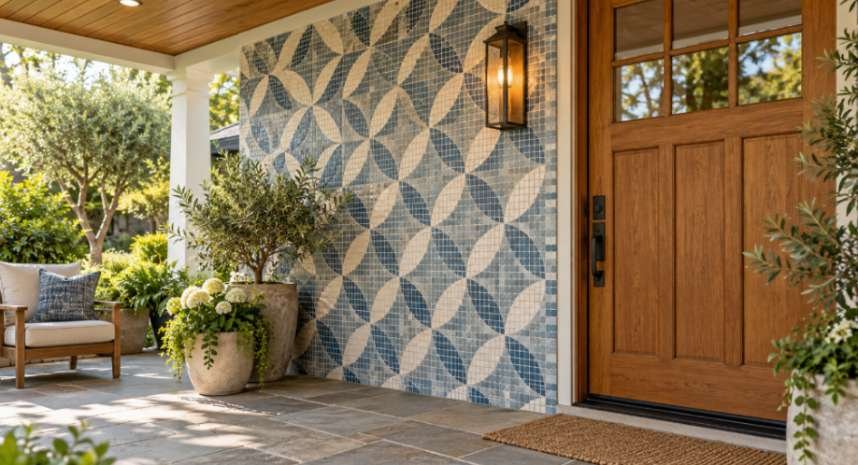
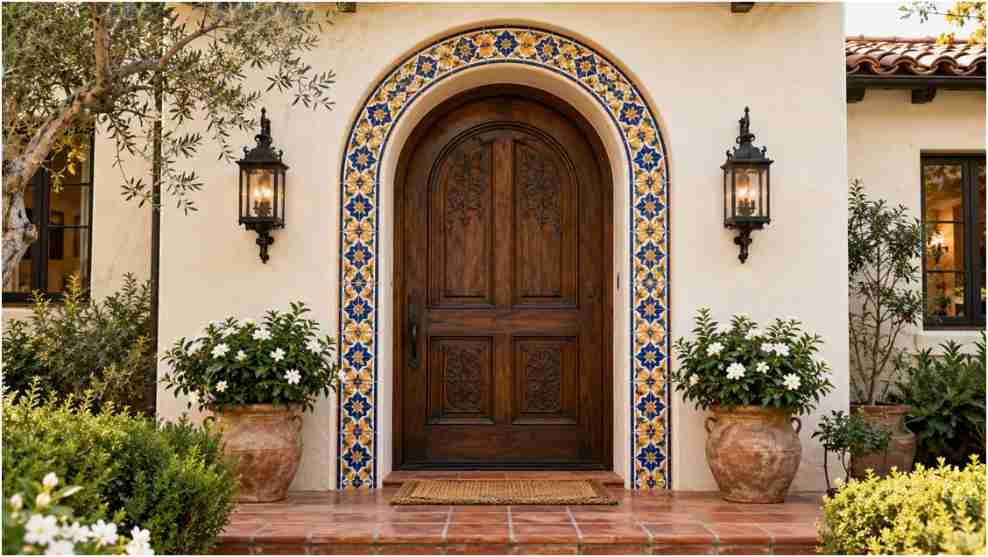
Nothing commands an entryway quite like hand-painted ceramic tracing a hand-troweled stucco curve. When I restored my first 1928 California revival home, the bare entryway felt flat, stark, and unfinished against the heavy timber front door.
Framing that portal with authentic ceramic transformed the entire facade from a plain stucco elevation into a handcrafted architectural focal point. Exploring spanish colonial exterior arched doorway tile framing ideas requires balancing historic geometry, vibrant Mediterranean glazes, and rigorous masonry engineering to ensure your border endures the elements.
Classic Layout Strategies for Arched Doorway Frames
The structural depth of your door framing dictates how tiles interact with light and shadow across your home’s exterior. Spanish Colonial Revival, Mission, and Andalusian architecture rely on three primary framing methods to outline entry arches.
[ Moorish Alfiz Frame ] [ Flush Border ] [ Recessed Jamb ]
+——————————-+ . – ~ – . . – ~ – .
| [Spandrel] [Spandrel] | : * * * * : : | | :
| * * * * . – ~ – . * * * | : * * : : | | :
| * * * : : * * | : * * : : |Door | :
| * * : DOOR : * | | * * | | |Jamb | |
| * * | | * | | * * | | |Tile | |
The Flush Arch Contour: Single vs. Double Ribbon Bands
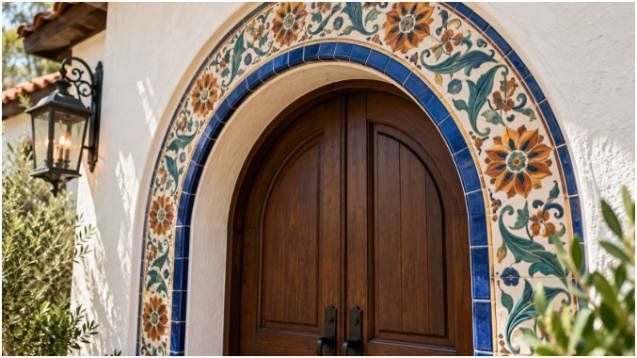
A flush border embeds the tile directly into the face of the stucco, creating a smooth transition across the elevation.
- Single Ribbon: A single run of four-inch square tiles creates a clean, graphic edge. This layout suits modest arched doorways where you want an intentional pop of cobalt or terracotta without overpowering nearby sconces or ironwork.
- Double Banding: For larger entrances, a double ribbon adds architectural gravity. I install a solid two-inch border tile (usually rich cobalt or raw umber) along the inner rim, followed by an intricate four-inch polychrome floral or geometric pattern along the outer ring. The solid inner band visually stabilizes the dynamic central pattern.
The Recessed Jamb Liner for Deep Stucco Portals
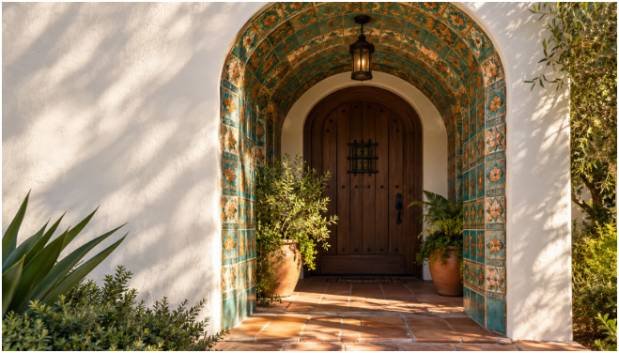
When an arched opening sits inside an eight-to-twelve-inch stucco wall, tiling the inside jamb produces a captivating reveal. The exterior face of the home remains pristine white masonry, but approaching visitors experience an immersive tunnel of pattern and color wrapping overhead.
Lining the jamb protects high-friction corner edges from everyday dings and chips. This interior lining coordinates effortlessly with a spanish style exterior house wall mosaic on adjacent courtyard elevations or tiled stair risers ascending your front porch steps.
The Historic Moorish Alfiz Rectangular Enclosure
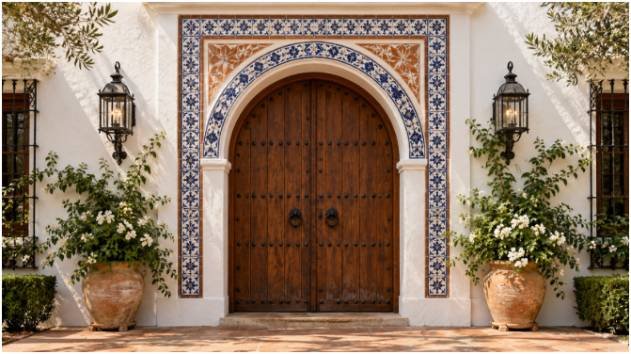
An alfiz consists of a continuous rectangular molding that frames the outer curve of an archway, a hallmark of southern Spanish and Moorish architecture. Instead of terminating the tile line at the spring line of the arch, carry the tilework outward into an expansive square frame that encloses the entire entrance.
The triangular wall spaces created between the curved arch and the rectangular outer frame—known as spandrels—become prime real estate for custom ceramic field patterns. You can fill these spandrels with solid terracotta field tiles, starburst arrangements, or intricate arabesque cuts. The alfiz turns a standard pedestrian doorway into a monumental hacienda gate.
Regional Tile Styles and Historic Color Palettes
Tile styles establish the historic narrative of your facade. Selecting the right glaze composition depends on the regional architectural style of your home.
+———————+———————————–+—————————————–+
| Tile Tradition | Characteristic Glazes | Ideal Facade Pairings |
+———————+———————————–+—————————————–+
| Mexican Talavera | Cobalt, marigold, emerald, cream | Textured white or sand-tone stucco |
| Malibu & Catalina | Muted turquoise, olive, persimmon | California Mission & Spanish Revival |
| Moroccan Zellige | Pearlescent ivory, pale celadon | Smooth Venetian plaster, modern coastal |
| Terracotta Brick | Earthy rust, raw umber, ochre | Rustic Santa Barbara & Tuscan styles |
+———————+———————————–+—————————————–+
Mexican Talavera and Hand-Painted Mayolica
Classic Talavera delivers unmistakable historic charm. Its milky white tin glaze provides an opaque canvas for high-contrast cobalt blue, marigold yellow, and forest green pigments. Because artisans hand-paint each piece, slight imperfections in line thickness and pigment pooling give the archway organic movement and hand-hewn authenticity.
California Mission Malibu and Catalina Glazes
Originating in the late 1920s, Malibu and Catalina tiles feature a distinctive dry-line (cuerda seca) firing technique. This process leaves crisp, dark outlines between intense pools of semi-matte glaze. The palette leans heavily into ocean teals, copper oranges, dusty sage, and lemon chiffon. These tiles harmonize naturally with dark wrought iron hardware and carved walnut doors.
Moroccan Zellige and Terracotta Thin-Brick
If intricate floral motifs clash with your minimalist aesthetic, handcrafted Zellige tiles offer subtle luxury. Chiseled by hand from unrefined clay, each glossy square exhibits irregular surfaces and delicate tone shifts. When catching late afternoon sunlight, an arch wrapped in pearlescent ivory or faded celadon Zellige bounces light dynamically.
Alternatively, unglazed terracotta thin-brick strips produce an earthy, grounded entryway. Terracotta provides rich tactile warmth without the visual busyness of geometric glazes.
The Masonry Formula: Sizing Tiles to Match Arch Curvature
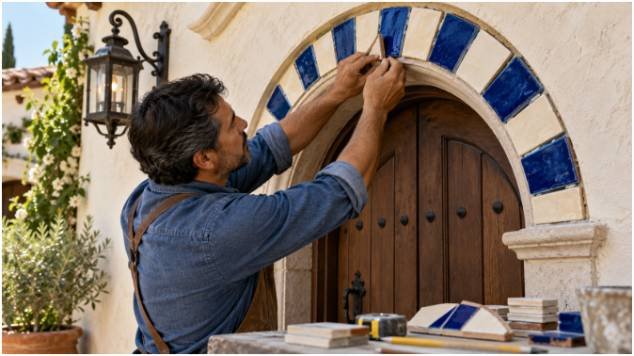
Laying square tiles along a curved masonry radius requires precise geometric calculations to avoid unsightly wedge-shaped grout lines.
R = Outer Arch Radius
/
/
. – ~ – . <— Arch Crown
: | :
: | :
: ( r ) : r = Inner Arch Radius
: | :
+———-+———-+
| |
| DOORWAY |
The golden rule for arched door framing: The tile dimension along the curve must decrease as the arch radius tightens.
For a standard entry door with a three-foot arch radius (36 inches):
- Standard four-inch square tiles will force grout joints that measure 1/8-inch at the inner jamb but expand to nearly 1/2-inch at the outer rim.
- Uneven joints look clumsy and invite moisture penetration.
To maintain uniform grout joints under 3/16-inch:
- Use custom-molded wedge tiles (keystone shapes) designed specifically for curved framing.
- Step down to two-inch mosaic squares, which bend around a 36-inch radius with minimal taper.
- Bevel-cut the side edges of four-inch tiles on a wet saw at a slight radial angle (typically 1.5 to 3 degrees per edge, depending on your radius).
If you love intricate geometry, applying mosaic tiles on outdoor concrete wall areas adjacent to the door provides an ideal testing ground for dialing in your grout gaps before tackling the main entry header.
Exterior Substrate Preparation and Weatherproofing
Exterior tile failures stem almost universally from water intrusion and thermal movement behind the mortar bed. Follow strict preservation and building practices, such as those documented in the National Park Service Historic Preservation Briefs, when retrofitting historic masonry.
Managing Thermal Expansion Along Curved Stucco
Stucco and ceramic expand and contract at different rates under solar exposure. A dark cobalt tile baking in midday sun expands significantly faster than the pale lime-stucco surrounding it.
To prevent debonding and hairline stucco cracking:
- Never tile directly over existing finish-coat stucco. The aggregate and color pigments in finish coats lack structural tension.
- Grind away the finish coat down to the scratch-and-brown base coat.
- Apply an ANSI A118.10-approved elastomeric waterproofing and crack-isolation membrane over the cured concrete substrate before setting tiles.
- Maintain a continuous 1/8-inch soft expansion joint filled with color-matched ASTM C920 silicone sealant where the outer edge of the tile meets the stucco field.
Mortar Chemistry and Freeze-Thaw Vitrification
If you live in USDA Hardiness Zones 7 or lower, winter freeze-thaw cycles present a real threat. Standard low-fired earthenware tiles absorb water like a sponge. When trapped water freezes, it expands by 9%, popping the glaze off the tile body or cleaving the tile in half.
Review guidelines from the Tile Council of North America (TCNA) regarding exterior exposure classes. Source exclusively vitrified (water absorption between 0.5% and 3%) or impervious porcelain (water absorption below 0.5%) exterior-rated tiles.
Install your tile using an ANSI A118.15-rated, polymer-modified thin-set mortar, such as those engineered by Custom Building Products Technical Data. This mortar class provides the high bond strength and shear flexibility needed to absorb structural shifts without shearing off your investment. Seal all joints using premium epoxy or high-performance urethane grout to block moisture paths permanently.
Frequently Asked Questions
1. Can I tile over existing exterior stucco around my doorway?
Only if you grind off the exterior finish coat down to the structural brown coat, apply a crack-isolation membrane, and use an ANSI A118.15-rated thin-set.
2. How do I prevent exterior archway tiles from cracking in winter?
Install vitrified or porcelain tiles with water absorption ratings under 0.5% set with flexible, polymer-modified mortar and sealed with urethane or epoxy grout.
3. What tile size works best for framing an exterior arched door?
Two-inch mosaics or radial-cut three-inch tiles conform naturally to standard arches without creating wide, tapered grout lines at the outer edge.
4. What is the historic name for the square frame enclosing a Spanish arch?
The rectangular frame enclosing an arch is called an alfiz, a traditional feature of Moorish and Spanish architectural facades.
Crown Your Entryway with Handcrafted Precision
Framing an exterior archway with historic tile instantly transforms a plain facade into an architectural showpiece. Pay close attention to your arch’s radius calculations, source exterior-rated vitrified glazes, and invest in high-grade crack membranes.
Plan your framing layout carefully, dry-fit your tiles across the curve before opening your mortar bucket, and build an entryway that weathers generations with effortless elegance.