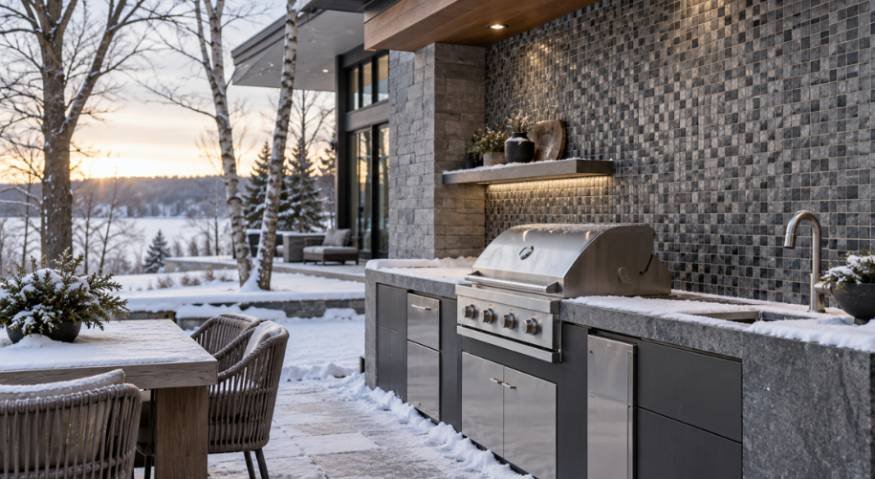
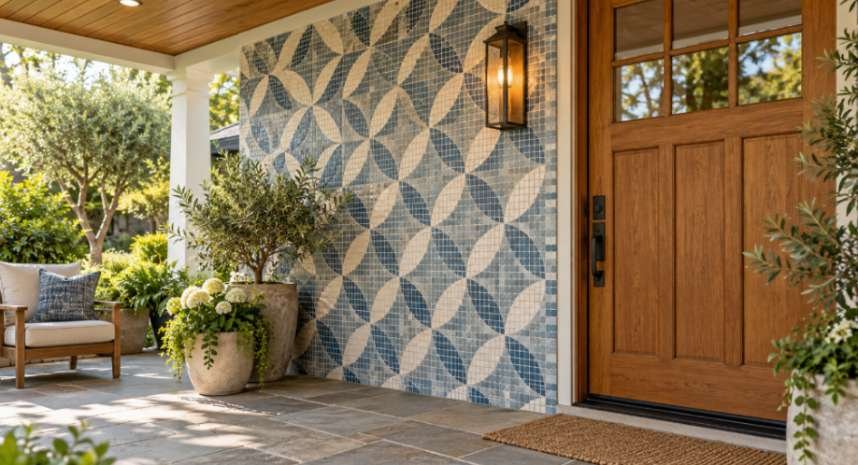
Building a weatherproof mosaic tile accent wall for front porch entries elevated my home’s curb appeal while solving a persistent exterior maintenance headache. Porch elevations face relentless driving rain, intense solar ultraviolet degradation, and severe seasonal freeze-thaw cycles.
When you mount tiny tesserae outdoors, conventional indoor methods fail within two seasons. Water creeps behind the tiles, freezes, expands, and shears the entire mosaic sheet off the wall.
By applying commercial-grade exterior substrate preparation and modified chemical mortars, you create an entrance facade that survives decades of harsh weather.
The Physics of Outdoor Tile Failure on Entry Porches

Exterior porches present severe environmental stresses that indoor bathrooms never encounter. Direct wind loads drive moisture deep into the smallest grout pinholes. Solar radiation heats exterior walls past 140°F in peak summer, causing rapid thermal expansion.
+————————————————————–+
| OUTDOOR EXPOSURE FORCES |
| |
| [ Solar Radiation / UV ] [ Driving Rain / Runoff ] |
| │ │ |
| ▼ ▼ |
| Thermal Expansion / Shock Capillary Water Absorption |
| │ │ |
| └───────────────┬───────────────┘ |
| │ |
| ▼ |
| Freeze-Thaw Frost Wedging |
| │ |
| ▼ |
| Shear Stress at Mortar Line |
| │ |
| ▼ |
| [ DELAMINATION / COMPLETE FACADE FAILURE ] |
+————————————————————–+
Freeze-Thaw Thermal Shear and Moisture Infiltration
Water expands roughly 9% in volume when freezing. When an exterior wall assembly absorbs moisture through porous grout, sudden frost forces water crystals into microscopic masonry pockets. This dynamic, known as frost wedging, pops the mosaic tiles cleanly off their adhesive bed. According to structural guidelines detailed in the TCNA Handbook Standards, exterior vertical installations demand continuous moisture management and decoupled expansion joints to mitigate structural shear.
Wood substrates underneath porch walls expand and contract at rates wildly different from glass or ceramic. Fastening mosaics over exterior plywood or oriented strand board guarantees delamination because organic wood swells when humidity climbs.
Selecting Zero-Porosity Tesserae: Glass vs Porcelain
Material selection dictates weather resistance. You must verify the water absorption rate of your chosen material before setting a single sheet. Porous tiles absorb moisture like sponges, making them unsuitable for open porches.
| Tile Material | Water Absorption Rate | Freeze-Thaw Performance | Outdoor Durability Assessment |
| Vitrified Glass | $< 0.1\%$ (Impervious) | Immune to frost expansion | Optimal for radiant porch walls; complete UV stability |
| Glazed Porcelain | $< 0.5\%$ (Impervious) | Exceptional frost resistance | Ideal for high-traffic entryways and heavy weather |
| Natural Slate | $0.5\% – 2.0\%$ (Vitreous) | High if cleft plane is dense | Requires regular sealers to avoid mineral flaking |
| Unglazed Terracotta | $> 8.0\%$ (Non-vitreous) | Fails rapidly in freezes | Unusable outdoors without continuous shelter |
Vitrified glass sheets provide the ultimate defense against moisture damage because their non-porous structure completely blocks water absorption. High-density glazed porcelain acts similarly, offering outstanding mechanical rigidity. For authentic natural stones, check technical density ratings indexed through the US Geological Survey to avoid sedimentary stones that split under sustained winter freezing.
Substrate Engineering: Moving Beyond Wood Subfloors
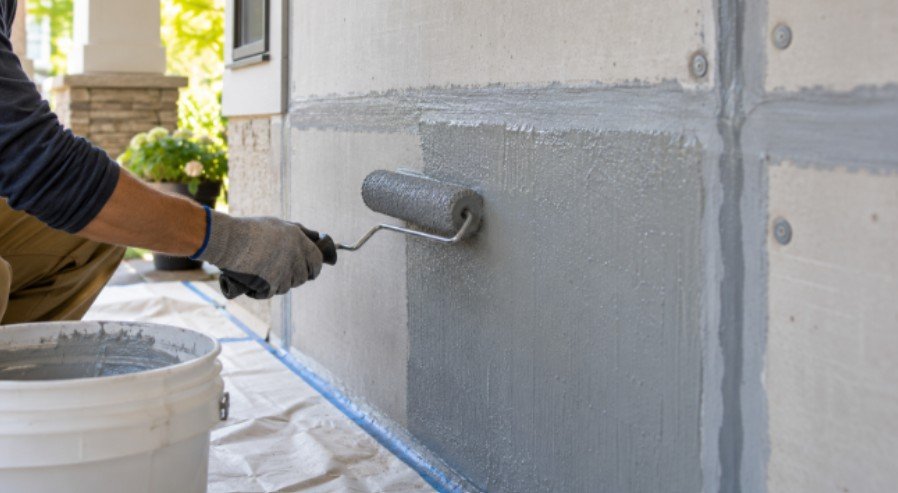
Never mount an outdoor mosaic directly over house wrap, exterior sheathing, or standard gypsum boards. A sturdy, weatherproof facade requires an inorganic, dimensionally stable foundation.
+————————————————————–+
| WEATHERPROOF EXTERIOR WALL CROSS-SECTION |
| |
| [ Porch Framing Studs (16″ O.C.) ] |
| [ 1/2″ Exterior Cement Backer Board (Alkali-Resistant Screws)|
| [ High-Performance Liquid Waterproofing Membrane (2 Coats) ]|
| [ ANSI A118.15 Polymer-Modified Thin-Set Mortar Bed ] |
| [ Mesh-Backed Mosaic Tiles (95%+ Mortar Coverage) ] |
| [ Chemical-Resistant Epoxy Grout ] |
+————————————————————–+
Installing Cement Backer Units and Liquid Membranes
Hang 1/2-inch exterior-grade cement backer boards directly to your porch framing studs spaced 16 inches on center. Fasten the boards using corrosion-resistant, alkali-resistant coated screws driven flush every 8 inches. Leave a 1/8-inch gap between board sheets to accommodate structural shifting.
Seal every joint with high-strength alkali-resistant fiberglass mesh tape embedded in polymer-modified mortar. Once dry, roll two continuous coats of an elastomeric liquid waterproofing and crack-isolation membrane across the entire surface. This continuous rubberized barrier ensures any wind-driven moisture that penetrates the tile layer drains away safely without reaching your home framing.
Incorporating Movement Joints for Thermal Creep
Exterior walls expand when baking in summer sunlight and contract dramatically during freezing winter nights. Fastening rigid tile edge-to-edge against porch columns or soffits causes internal stresses to build until the tiles tent and buckle.
Isolate your mosaic panel by leaving a 1/4-inch movement joint at all perimeter intersections, changes in substrate planes, and abutting architectural trim. Fill these perimeter channels with outdoor-rated, color-matched silicone or polyurethane sealant rather than rigid grout.
For a complete entrance upgrade, consider slip-resistant exterior mosaic tiles for front entryway steps to complement the porch accent wall with a safer, coordinated finish underfoot, particularly in areas exposed to rain.
Applying Mortar and Mesh-Backed Sheets Without Squeeze-Out
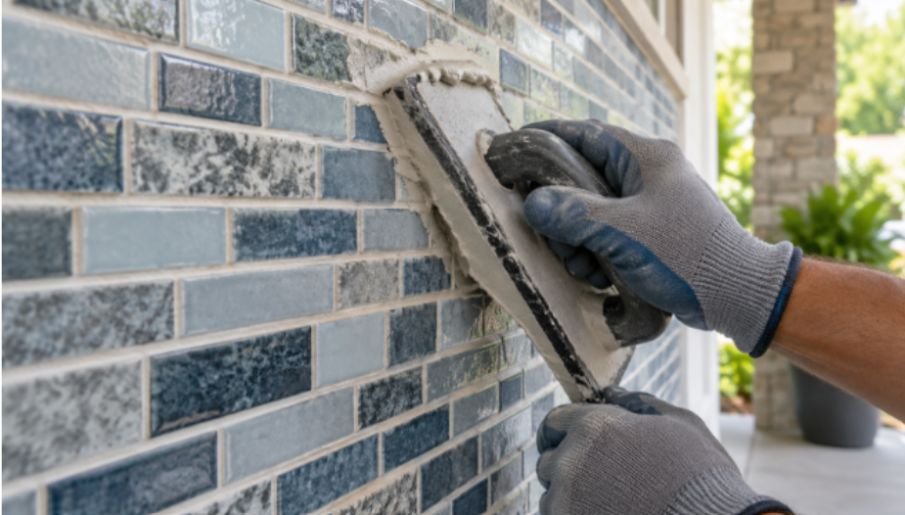
Exterior installations require at least 95% continuous mortar contact behind every mosaic piece. Air voids trap water, and trapped water inevitably freezes and pops the tiles loose.
TROWELING RIDGE TECHNIQUE
Step 1: Comb Ridges Step 2: Flatten Crests
▲ ▲ ▲ ▲ ▲ ───────────────────
│ │ │ │ │ │ │ │ │ │ =======> Smooth Bed Layer
▼ ▼ ▼ ▼ ▼ (Prevents Squeeze-Out)
[ 3/16″ V-Notch Combing ] [ Flat Trowel Knockdown ]
The ANSI A118.15 Thin-Set Ridge Knock-Down Technique
Standard indoor adhesives dissolve when subjected to sustained outdoor humidity. Specify a high-performance, polymer-modified mortar meeting ANSI A118 Specifications for exterior freeze-thaw endurance. These high-tack mortars bond tenaciously to non-porous glass and dense porcelain.
Comb your mixed mortar onto the wall with a 3/16-inch V-notch trowel. Then, apply a critical technique: lightly skim the flat side of your trowel across the ridges to flatten their crests before setting the mosaic. Mesh-backed sheets sink into this flattened bed evenly. This simple adjustment provides full 95% adhesive contact while preventing mortar from bubbling up into your grout channels.
Uniform Embedding with a Beating Block
- Position the mosaic sheet squarely along your plumb chalk line.
- Hold a flat wooden beating block or dense rubber float against the tile face.
- Tap the block systematically using a rubber mallet across the entire panel.
- Rake out any adhesive that squeezes into the upper third of the grout joints using a wooden toothpick before it cures.
Epoxy Grout: The Ultimate Shield Against Driven Rain
Standard cementitious grout behaves like a rigid sponge, absorbing water and collecting airborne mildew. For a truly weatherproof installation, use a two-part reactive epoxy grout. Epoxy forms a non-porous plastic-resin matrix that cures into an impenetrable water barrier.
+————————————————————-+
| EPOXY GROUT APPLICATION SEQUENCE |
| |
| [ Blend Resin + Hardener ] |
| │ |
| ▼ |
| [ Add Color Quartz Fillers ] |
| │ |
| ▼ |
| [ Pack Joints at 45° Angle with Hard Rubber Float ] |
| │ |
| ▼ |
| [ Strike Face at 90° to Shear Excess Resin ] |
| │ |
| ▼ |
| [ Emulsify Residue via Nylon Scrub Pad (15 Min Window) ] |
| │ |
| ▼ |
| [ Clean Hydro-Sponge Pass Along Diagonal Axis ] |
+————————————————————-+
Emulsification Timing and Residue Control
Epoxy grout cures via an exothermic chemical process that depends heavily on ambient air temperature. In hot porch environments, your working window drops quickly:
- Mix in Controlled Batches: Mix only what you can spread and wash within 25 minutes. Never add water to adjust viscosity.
- Firm Joint Packing: Pack the joints completely by holding your float at a 45-degree angle. Then, tip your float up to a crisp 90-degree angle and strike across the tile face diagonally to strip excess epoxy.
- Rapid Emulsification: Wait roughly 15 minutes, then wet the wall with warm wash water mixed with manufacturer-approved neutral cleaning solution. Scour in tight circles using a white nylon scrubbing pad to emulsify surface resin without dislodging joints.
- Diagonal Sponge Sweeps: Sweep a dense cellulose sponge across the wall diagonally in a single continuous stroke. Turn the sponge to a clean face for each pass to eliminate sticky epoxy haze.
Exterior Front Elevation Aesthetics and Styles
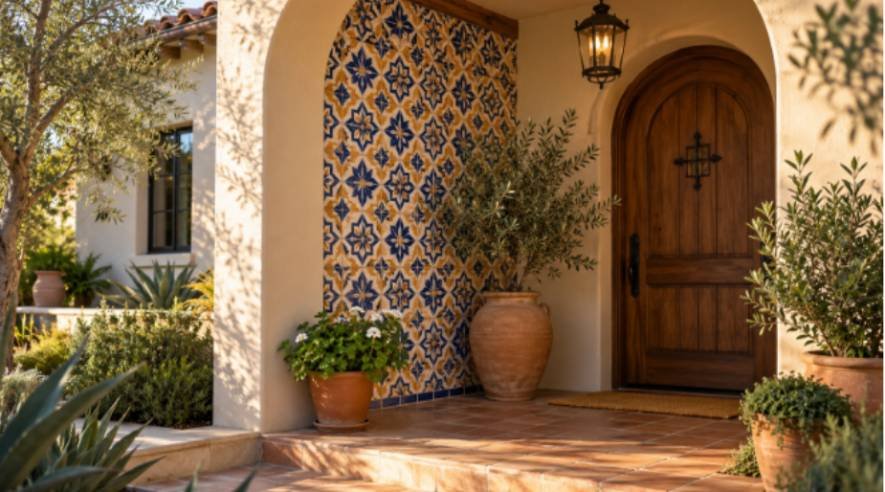
A mosaic accent wall acts as a sophisticated visual anchor for your entire facade. If your home features arched doorways, warm terracotta roof tiles, or stucco textures, designing a porch feature around a spanish style exterior house pairs exceptionally well with cobalt, gold, and white geometric tile motifs. These bright, contrasting patterns reflect daylight into shaded porch entries.
For crisp lines, industrial metal hardware, and minimalist framing, selecting modern house front elevation tiles in monochromatic basalt, dark charcoal glass, or honed chevron quartzite creates a striking, streamlined entryway. Natural materials blend seamlessly with outdoor foliage while delivering bulletproof weather performance.
Frequently Asked Questions
1. Can I install mosaic mesh sheets directly over existing exterior brick?
Yes, provided the brick is structurally sound, unpainted, power-washed clean, and coated with a leveling mortar bed.
2. Will epoxy grout turn yellow on a sunny front porch?
Standard epoxies can discolor, but UV-stable exterior formulas containing aliphatic resins prevent yellowing caused by sunlight exposure.
3. What is the lowest temperature required to install outdoor thin-set?
Exterior mortar and epoxy grout require steady temperatures above 50°F (10°C) for at least 48 hours to cure properly.
4. Do glass mosaic tiles crack when winter temperatures drop below zero?
Vitrified glass will not crack from freezing air because it absorbs virtually no water to cause internal expansion.
Porch Perfection Awaits Your Trowel
Transforming an ordinary entryway into a striking architectural statement requires respecting the structural demands of outdoor weather. Cut no corners on substrate prep, lock out moisture with dedicated waterproofing membranes, and seal the facade with rugged epoxy grout. Pick up your trowel, snap your guide lines, and build a front porch feature that commands attention through every season.