
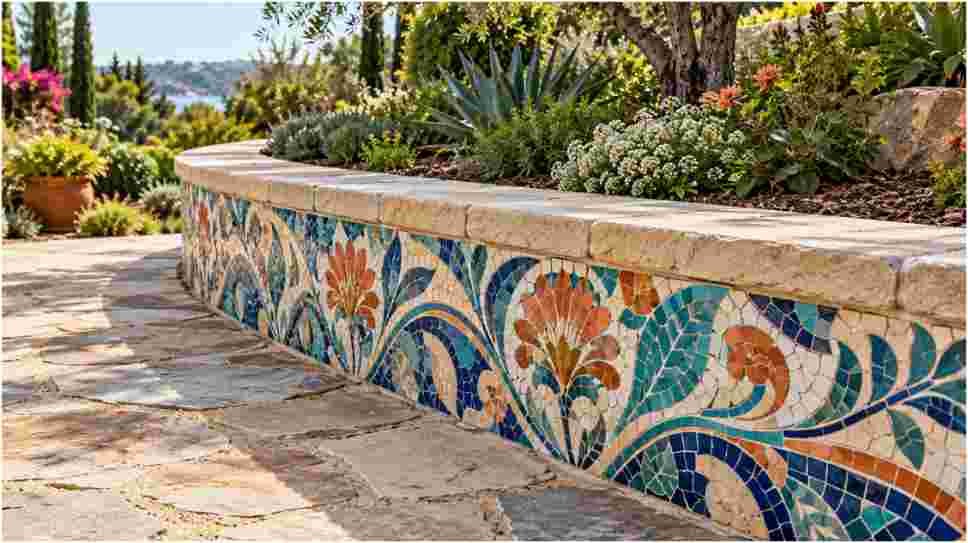
Bare concrete retaining walls ruin landscape aesthetics faster than weed-choked lawn beds. I spent years rebuilding cracked, spalling masonry installations because homeowners treated exterior earth-retention structures like ordinary living room backsplashes.
This outdoor retaining wall ceramic mosaic tile design guide covers the structural physics, material ratings, and adhesive chemistry required to build a permanent, weather-resistant landscape centerpiece that withstands seasonal soil shifts and blistering heat cycles.
Structural Reality: Retaining Walls Are Not Standard Walls
Retaining walls fight active gravity and moisture loads 24 hours a day. Unlike a patio garden barrier or foundation wall, an earth-retentive structure acts as a dam holding tons of saturated soil. Moisture naturally moves through porous concrete masonry units (CMUs) via capillary action, searching for an exit point on the exposed exterior face.
+————————————————————–+
| SOIL RETENTION SYSTEM |
+————————————————————–+
| Saturated Backfill Soil |
| │ |
| ▼ (Water migrates forward via capillary action) |
| Geotextile Fabric + Crushed Aggregate Backfill |
| │ |
| ▼ (Gravity drops water to base) |
| Perforated PVC Drain Pipe -> Weep Holes Exit Base |
| │ |
| ▼ (Residual moisture hits rear wall) |
| Poured Concrete / CMU Core (Waterproofed on rear) |
| │ |
| ▼ (Thermal movement pushes outward) |
| ANSI A118.10 Anti-Fracture Elastomeric Membrane (Face) |
| │ |
| ▼ (ANSI A118.15 Polymer Mortar, 95% collapsed ridges) |
| Vitrified Porcelain / Impervious Ceramic Mosaic Tesserae |
+————————————————————–+
The Hydrostatic Pressure Trap
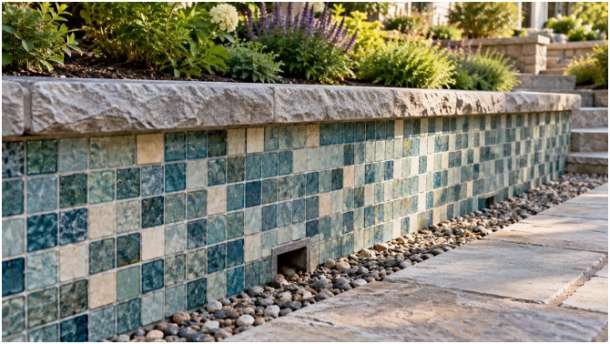
If you tile directly over raw cinder blocks without redirecting moisture, groundwater dissolves salts within the concrete core. This produces efflorescence. The resulting crystalline pressure pops tiles off the substrate within a single winter.
A resilient installation requires a dedicated drainage field behind the wall before you mix thin-set. The structural framework documented by the International Association of Certified Home Inspectors (InterNACHI) specifies a back-of-wall gravel trench with perforated PVC pipes wrapped in geotextile fabric. Clear weep holes spaced every six to eight feet along the bottom plate allow trapped water to bleed off before it attacks your adhesive layer.
Thermal Expansion and Shear Stress Realities
Direct solar radiation causes massive surface temperature swings. A south-facing retaining wall in Arizona or Texas fluctuates between 45°F at dawn and 140°F by mid-afternoon. Ceramic expands under heat; concrete expands at a completely different rate. This differential movement creates tremendous shear stress. Without dedicated movement joints, the tile layer buckles outward in a structural failure called tenting.
Technical Material Selection for Exterior Longevity

Standard indoor kitchen tiles absorb water and crumble outdoors. High moisture absorption causes interior tesserae to shatter during freeze-thaw cycles. Choosing durable tiles requires verifying technical product datasheets rather than relying on surface glazes.
+———————–+——————+—————————–+
| Material Class | Water Absorption | Exterior Wall Suitability |
+———————–+——————+—————————–+
| Non-Vitreous Ceramic | > 7.0% | Unacceptable; freeze damage |
| Semi-Vitreous Ceramic | 3.0% – 7.0% | Interior walls only |
| Vitreous Ceramic | 0.5% – 3.0% | Mild, non-freeze zones only |
| Impervious Porcelain | < 0.5% | Universal; freeze-thaw safe |
+———————–+——————+—————————–+
Vitrification and Water Absorption Ratings
Only select vitrified or impervious porcelain mosaic elements. The ASTM C373 test standard measures water absorption by weight:
AbsorptionPercentage=Msaturated–MdryMdry100
Aim for an absorption rate at or below 0.5%. When moisture penetrates unvitrified clay matrices, freezing temperatures expand trapped water by roughly 9% in volume, shattering glazes instantly. If you plan to incorporate vibrant, hand-painted mexican ceramic tile as decorative accent medallions, seal every edge thoroughly and place them strictly in sheltered niches above frost lines.
Sheet Backing Chemistry: Avoiding Water-Soluble Mesh
Common interior mosaic sheets use fiberglass mesh glued with polyvinyl acetate (PVA). Water dissolves PVA glue. When damp ground conditions soften this adhesive layer, the tile loses its bond to the mortar bed.
Select film-faced, paper-faced, or back-knotted polymer mesh systems. Front-faced paper mounting leaves 100% of the rear ceramic body exposed to the thin-set bed, ensuring full adhesive contact.
Design Layouts and Architectural Styling
Retaining walls possess wide physical expanses that break monotonous flat planes. Mosaics allow you to introduce bold landscape textures, flowing lines, and vibrant garden focal points.
Mediterranean Trencadís and Broken-Shard Curves
Popularized by Antoni Gaudí in Barcelona, the trencadís technique uses broken ceramic shards pieced together organically. This design shines on undulating, curved serpentine retaining walls where rigid rectangular tiles buckle or require excessive cuts.
I source high-fire glazed ceramic and salvage broken frost-rated stoneware plates. Stagger your shard spacing between 1/8-inch and 1/4-inch to accommodate shifting angles. The resulting flowing visual softens bulky structural concrete, blending retaining contours directly into surrounding garden foliage.
Contemporary Coping Borders and Geometric Accents

If covering an entire fifty-foot retaining wall feels overwhelming, focus on clean borders. Line the top coping overhang or the stair risers cutting through the wall face with repeating geometric bands.
Moroccan star motifs, chevron patterns, and monochrome subway mosaics break up monolithic stone. You can also build an interactive landscape feature by constructing a localized diy outdoor mosaic tile medallion directly behind a water fountain or fire pit seating zone.
Step-by-Step Installation Protocols That Prevent Failure
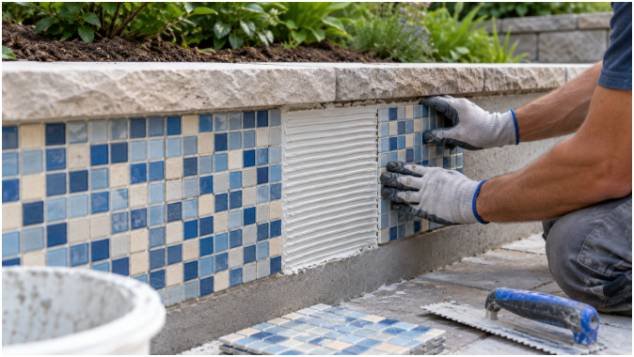
Long-lasting exterior installations require disciplined, sequential layering. Skipping curing times or compromising on adhesive coverage ruins the finished project.
Surface Prep and ANSI A118.10 Membranes
Never tile over painted, crumbling, or dirty masonry. Pressure-wash the concrete face with a 3,000 PSI wash to remove efflorescence, oil, and laitance. Grind down high spots and fill low gouges with an exterior-rated polymer-modified rendering coat.
Once cured, roll two coats of a liquid waterproofing membrane meeting ANSI A118.10 standards, such as Custom Building Products RedGard. This elastomeric barrier stops hairline substrate cracks from transferring through your tiles while preventing efflorescence salts from staining the finished face.
Mortar Ridge Collapsing for 95 Percent Coverage
Standard interior tiling targets 80% mortar coverage. Exterior installations demand at least 95% continuous coverage without open air pockets. Voids trap pooling moisture; trapped moisture expands during winter freezes and pops the mosaic loose.
Use an improved modified dry-set mortar meeting ANSI A118.15 standards, such as Laticrete 254 Platinum. Comb your mortar using a 3/16-inch V-notch trowel in straight, horizontal lines. Press your mosaic sheet firmly into the wet bed, then beat the face flat with a rubber-faced beating block and mallet. This action collapses the trowel ridges into a continuous, void-free adhesive layer.
INCORRECT (Traps Moisture) CORRECT (Collapsed Ridges)
┌───┐ ┌───┐ ┌───┐ ┌───┐ ┌───┐ ┌───┐ ┌───┐ ┌───┐
│ │ │ │ │ │ │ │ <- Tiles -> │ │ │ │ │ │ │ │
└───┘ └───┘ └───┘ └───┘ └───┘ └───┘ └───┘ └───┘
▲ ▲ ▲ ▲ ═══════════════════════
│ │ │ │ Solid 95%+ Mortar Bed
Open Air Voids Trap Water (No Voids / No Freezing)
═══════════════════════ ───────────────────────
Concrete Core Substrate Concrete Core Substrate
Grout Selection and ASTM C920 Soft Joints
Fill your joints with a high-performance, polymer-modified cement grout meeting ANSI A118.7 standards, or step up to a 100% solids epoxy grout. Epoxy cures non-porous, repelling dirt, garden fertilizer chemicals, and freeze-thaw cycles completely.
Never run rigid grout through corners or across long horizontal runs. The Tile Council of North America (TCNA) Method EJ171 requires dedicated expansion joints every 8 to 12 feet on exterior vertical walls exposed to direct sun.
Fill these expansion gaps with a color-matched, non-sag polyurethane or 100% silicone sealant meeting ASTM C920 specifications. These soft joints compress safely as the retaining wall shifts with seasonal heat.
Frequently Asked Questions About Retaining Wall Mosaics
1. Can I install mosaic tiles directly over an old painted retaining wall?
No, paint compromises thin-set adhesion; you must mechanically grind or sandblast the paint down to raw, porous masonry before tiling.
2. What is the minimum thickness required for exterior wall mosaics?
Use ceramic or porcelain tesserae between 6mm and 8mm thick to ensure mechanical strength without overloading the vertical wall face with excess weight.
3. How wide should the top coping stone overhang be above the mosaic?
The coping cap must overhang the finished mosaic face by at least 1 inch and feature a bottom-cut drip groove to shed rainwater away from the tile joints.
4. Can standard bathroom mastic adhesive work on outdoor retaining walls?
Never use mastic outdoors; organic adhesives emulsify when exposed to moisture and rot rapidly under continuous humidity.
Stop Staring at Bare Gray Concrete
Transforming a gray structural wall into an art installation takes patience, proper membrane layering, and weather-rated materials. Treat the physics of moisture control with the respect it deserves, source vitrified porcelain, and honor your expansion joints.
Grab your trowel, clear the weep holes, and begin laying your mosaic pattern on a clean, waterproofed concrete canvas today.