

In breweries, dairies, food packaging plants, and pharmaceutical facilities, glycol chiller systems are the backbone of production. Circulating sub-freezing fluid through jacketed tanks and heat exchangers maintains precise process temperatures, controls fermentation, and protects batch quality.
While facility teams routinely check compressors and coils, the plumbing distribution network is where major failures take root. Chilled propylene glycol operates under sub-freezing temperatures, searches out microscopic piping flaws, and turns corrosive if chemical buffers degrade.
When piping suffers from hydraulic imbalances, compromised insulation, or chemical breakdown, chillers work double-time to compensate. Overlooking plumbing symptoms leads to frozen evaporators, ruptured lines, and costly downtime. Here are six critical red flags in commercial glycol chiller plumbing that demand immediate attention.
1. Chronic Pipe Sweating and Breached Vapor Barriers
The quick answer: Condensation or frost along chilled lines indicates a breached vapor barrier, leading to immediate thermal loss and aggressive pipe corrosion beneath the insulation.
Commercial glycol lines typically operate between 20°F and 30°F, far below the atmospheric dew point. Preventing moisture condensation requires continuous closed-cell elastomeric insulation. If insulation tears, unseals at glued seams, or crushes under pipe hangers, ambient humidity condenses against cold pipe surfaces instantly.
A compromised chiller pipe insulation vapor barrier allows water to pool beneath protective jacketing. In steel or copper systems, this triggers Corrosion Under Insulation (CUI), thinning pipe walls until pinhole leaks emerge. Furthermore, saturated insulation loses up to 80% of its thermal resistance, forcing compressors to run continuously to fight thermal gain.
2. Unexplained Pressure Drops and Constant Glycol Top-Offs

The quick answer: Repeatedly adding makeup fluid or watching static pressure gauges fluctuate points to active micro-leaks across mechanical seals, threaded fittings, or valve stems.
A closed-loop glycol circuit should maintain stable static pressure. If your maintenance crew tops off the expansion tank weekly, fluid is actively escaping.
Because propylene glycol has lower surface tension than water, it penetrates micro-imperfections in threaded fittings, flange gaskets, and valve packings that water would never breach. Technicians should inspect automatic air vents, pump mechanical seals, solenoid valves, and tank connections for sticky residues, white crystallization, or sweet-smelling fluid.
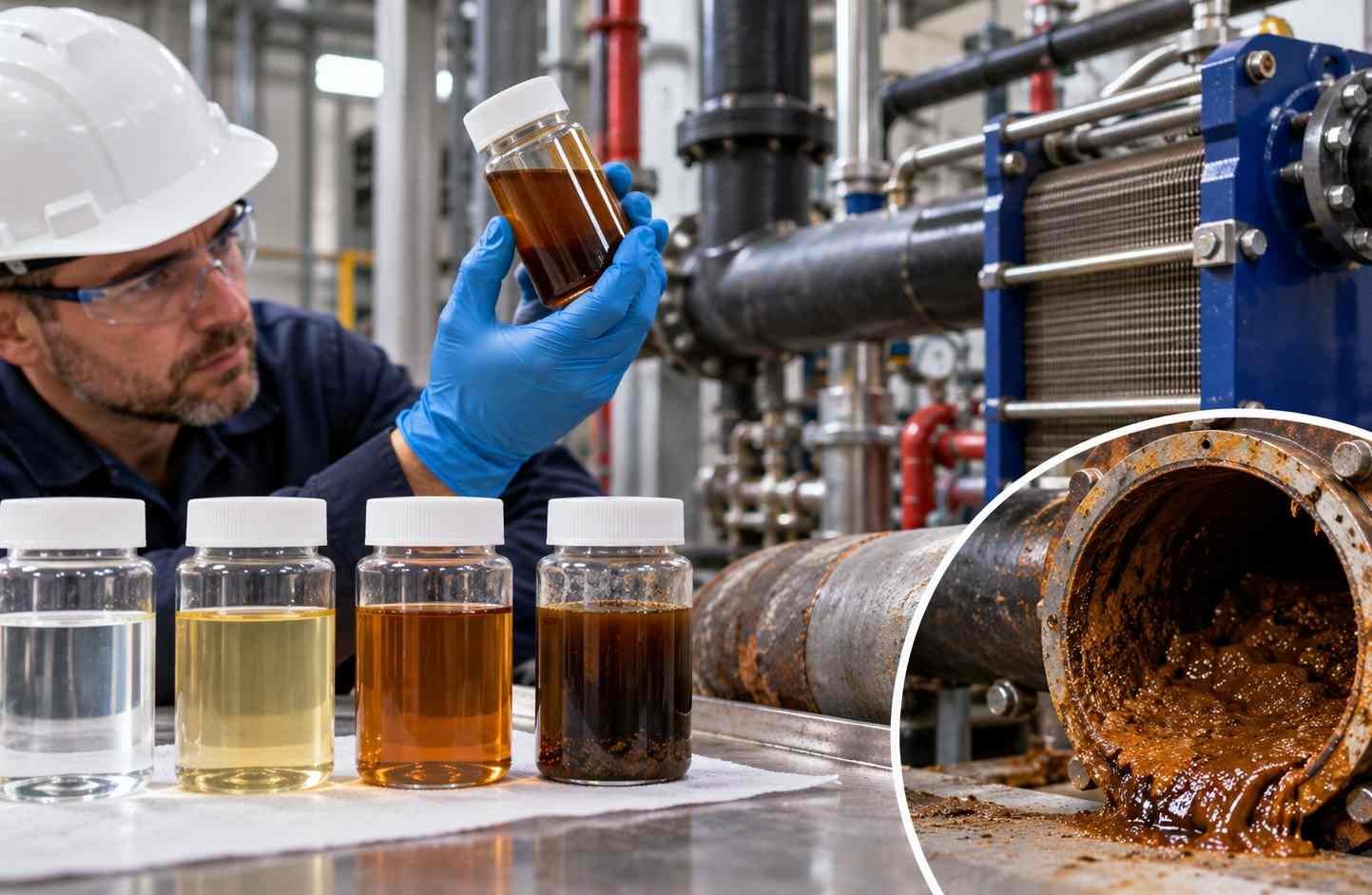
3. Discolored Fluid, Acidic pH, and Sludge Accumulation
The quick answer: Dark, amber, or foul-smelling glycol indicates thermal fluid breakdown and loss of buffering capacity, accelerating internal pipe corrosion and fouling heat exchangers.
Fresh propylene glycol is clear or tinted with fluorescent dyes. Over time, exposure to dissolved oxygen or localized hot spots breaks down glycol molecules into organic acids.
When fluid pH drops below 8.0, the mixture turns aggressively corrosive to copper, carbon steel, and brass. Maintaining an active glycol hydronic corrosion inhibitor package passivates internal metal surfaces and neutralizes acids. If samples appear cloudy, brown, or smell acidic, inhibitors are exhausted. The resulting rust sludge coats pipe walls, clogs solenoids, and diminishes heat transfer.
4. Temperature Stratification Across Process Vessels
The quick answer: Uneven temperatures between fermenters or process tanks signal hydraulic imbalances, undersized branch piping, or air bound within high-elevation piping loops.
In multi-tank facilities, supply headers must deliver balanced flow to every cooling zone. If vessels farthest from the chiller run several degrees warmer than tanks adjacent to the pump skid, the loop is hydraulically unbalanced.
Uniform cooling requires proper closed-loop glycol balancing. Direct-return piping often starves distant vessels. Converting to reverse-return layouts or installing calibrated circuit-balancing valves ensures every jacket receives designated flow regardless of line distance. Furthermore, air trapped at high points creates air locks that choke flow, requiring automatic air eliminators.
5. Pump Cavitation and Audible Hydraulic Rumbles
The quick answer:
Gravel-like rattling or high-pitched whining inside circulation pumps indicates low suction pressure, clogged strainers, or overly viscous glycol mixtures.
Circulation pumps are the heart of the glycol loop. When a pump emits a harsh rattling noise resembling gravel inside the casing, it is cavitating. Cavitation occurs when fluid pressure at the suction inlet drops below vapor pressure, forming vapor bubbles that implode violently against the impeller.
In glycol networks, cavitation stems from restricted suction plumbing: clogged Y-strainers, sharp elbows near pump inlets, or overly dense glycol concentrations. This highlights why professional installation matters for meta building safety, as proper pump placement, suction piping design, and system maintenance help prevent mechanical failures and maintain reliable cooling performance. Left uncorrected, cavitation pits impellers, ruins seals, and halts cooling to process lines.
6. Brittle Plastics and Incompatible Pipe Materials
The quick answer: Using standard PVC, unapproved plastics, or unisolated dissimilar metals causes pipe brittleness, sudden burst fractures, and aggressive galvanic corrosion.
One of the costliest plumbing errors is using unapproved piping materials. Standard Schedule 40 or 80 PVC becomes brittle at low temperatures, risking catastrophic burst fractures under fluid pressure surges.
Modern facilities rely on industrial thermoplastics like polypropylene (PP-R / PP-RCT) or pre-insulated ABS engineered for low-temperature refrigeration. When designing or upgrading process lines, sourcing certified specialty piping in Utah ensures you deploy materials engineered to withstand sub-zero hydronic cycles without brittleness, joint fatigue, or chemical degradation.
Monthly Glycol Plumbing Diagnostic Checklist
Review these mechanical checkpoints monthly to preserve chiller efficiency:
- Test Fluid Chemistry: Verify pH remains between 8.5 and 9.5; check freeze point with an optical refractometer.
- Inspect Vapor Barriers: Audit insulation seams around valves and hangers for frost or condensation.
- Clean Suction Strainers: Blow down Y-strainers ahead of pumps to prevent cavitation.
- Audit Valve Stations: Check jacket solenoid valves and manual bypasses for crystallized fluid.
- Verify System Pressure: Confirm static loop pressure matches design specifications when resting.
Maintaining a commercial glycol chiller requires equal attention to the mechanical equipment and the piping network distributing cooling capacity. Overlooking damaged insulation, fluid acidity, micro-leaks, and hydraulic imbalances forces equipment to work harder, inflating energy bills and risking batch loss. Regular fluid testing, intact vapor barriers, and certified piping materials ensure cooling loops operate reliably and efficiently across every production run.