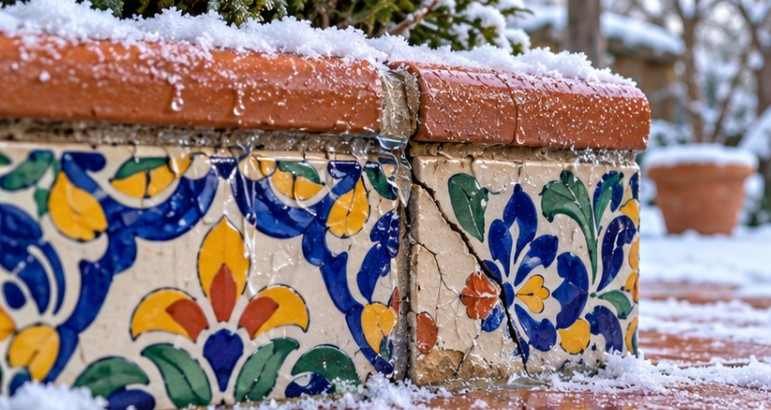
A beautiful glazed surface can hide Talavera tile’s biggest winter weakness: the clay underneath can still take on moisture. Once water reaches porous tile bodies, exposed edges, grout joints, or installation voids, repeated freezing and thawing can turn a small moisture problem into cracking, flaking, or loose tile.
That is why learning how to protect talavera tile from freezing weather is less about keeping the glazed face warm and more about keeping the entire installation as dry as possible.
The best strategy combines drainage, moisture control, proper sealing, sound grout, movement accommodation, and—in the case of portable Talavera—simply moving it out of the weather.
Why Freezing Weather Can Damage Talavera Tile
Traditional Talavera is a glazed earthenware product rather than the dense, low-absorption porcelain commonly chosen for exposed exterior installations.
The glaze may shed much of the water that lands directly on its face, but moisture can enter elsewhere: through grout, tile edges, an unglazed back, cracks, or gaps in the setting material.
That matters because freeze damage requires two ingredients: moisture and sufficiently low temperatures.
An American Concrete Institute technical presentation notes that frost deterioration generally requires significant internal moisture, with repeated freeze-thaw cycling increasing damage. Although the research concerns concrete, the underlying lesson applies broadly to porous exterior materials: reducing saturation substantially reduces winter risk.
The National Park Service likewise identifies freeze-thaw action as a cause of masonry cracking and deterioration, especially after water has penetrated porous material. For Talavera, that means winter protection starts before the thermometer reaches 32°F.
Start With the Simplest Fix: Move Portable Talavera Indoors
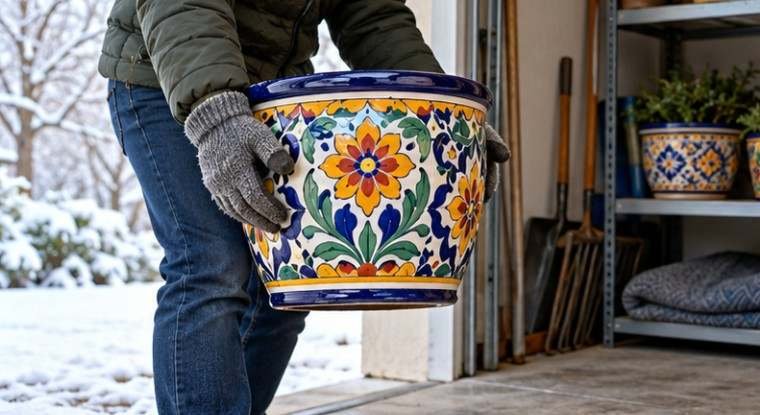
Talavera planters, decorative pots, garden stools, fountains, and removable tabletops should not spend a freezing winter outdoors simply because they survived the previous year.
Move portable pieces into a garage, shed, enclosed porch, basement, or another protected location before sustained freezing weather begins.
Planters deserve special attention. Wet potting soil can hold a large volume of moisture against the ceramic body for long periods. Illinois Extension notes that many containers may be damaged by repeated freezing and thawing and recommends emptying and storing vulnerable containers to prolong their life.
If a planter cannot be moved, empty it where practical and make certain drainage holes remain open. Keeping water from sitting inside the vessel is more useful than wrapping a saturated pot after cold weather arrives.
Keep Fixed Tile Dry Before the First Hard Freeze
Installed Talavera on stair risers, courtyard walls, outdoor kitchens, fountains, benches, or tabletops requires a different approach.
Fix Drainage Before Reaching for Sealer
Look at the installation immediately after rain. Does water remain along grout joints? Does it collect where a tiled wall meets a horizontal ledge? Does a tabletop have depressions that hold puddles? Does roof runoff repeatedly splash the same area?
Standing and recurring water exposure are warnings for talavera tile outdoor staircase risers. Correct blocked drains, leaking gutters, failed flashing, irrigation spray, and poorly draining joints where possible. Horizontal installations should shed water rather than allowing it to remain against tile. This is important because a sealer cannot compensate for an installation that is continually saturated.
Inspect Grout, Edges, and Cracks Carefully
Before winter, examine the tile installation from several angles rather than concentrating only on the decorative glaze.
Look for:
- cracked or missing grout
- separation around perimeter joints
- chipped tile exposing raw clay
- loose tiles
- failed sealant around transitions
- hollow areas suggesting incomplete bonding
- efflorescence or persistent darkening that may indicate moisture movement
Repair defects before sealing. The Ceramic Tile Education Foundation emphasizes that exterior tile installations move with temperature changes and require appropriate movement accommodation. It also warns that voids behind tile can collect water; in freezing environments, that trapped water can contribute to cracking or tile failure.
For an existing installation with widespread hollow tiles or recurring grout failure, surface maintenance alone may not solve the underlying problem.
Seal Strategically, Not Automatically
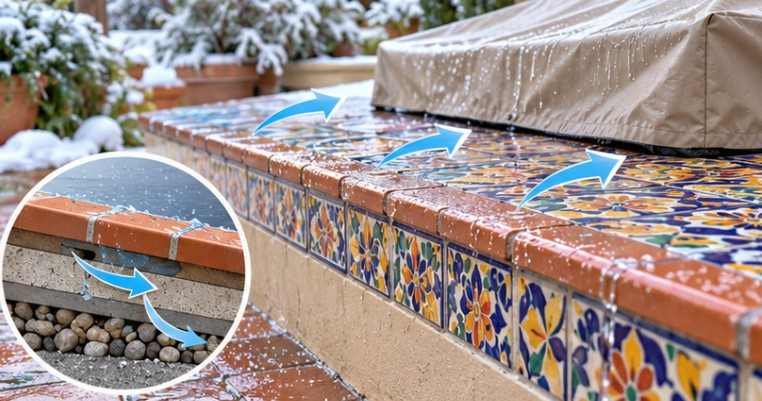
A suitable penetrating sealer can reduce water absorption through porous grout and exposed clay, but “more sealer” is not automatically better. The surface must first be clean and thoroughly dry. Applying a coating over moisture can trap rather than solve the problem.
Choose a product explicitly approved by its manufacturer for:
- exterior exposure
- the specific grout or ceramic material involved
- ultraviolet exposure
- freeze-thaw conditions
- moisture-vapor transmission requirements
Always test an inconspicuous area first, particularly with handmade tile. Sealers may affect color, sheen, or appearance. The Ceramic Tile Education Foundation advises considering UV resistance, freeze-thaw stability, moisture-vapor transmission, longevity, and reapplication requirements when selecting tile or stone sealers. Do not assume sealing makes ordinary Talavera “frost proof.” It simply reduces one route by which damaging moisture can enter.
Protect Horizontal Surfaces From Snow and Ice
Horizontal Talavera deserves more winter protection than a sheltered vertical backsplash because snow, freezing rain, and meltwater can remain on it. For fixed tabletops, benches, counters, and decorative ledges, use a properly fitted waterproof outdoor cover when the surface will not be used.
The cover should keep precipitation away without creating a basin that holds water against the tile. Maintain enough pitch for rainfall and melting snow to drain. Avoid trapping an already wet installation beneath an impermeable cover. Allow it to dry first.
Be Extremely Careful With De-Icing Salts

Rock salt and other deicers are poor companions for decorative ceramic installations. Salt-laden water can migrate into porous grout and adjacent materials, while some deicing chemicals can accelerate deterioration of hardscape materials.
University of Minnesota Extension reports that excessive deicer use can degrade concrete, asphalt, and natural stone, while chloride runoff also creates environmental problems.
For Talavera steps or nearby walkways, mechanically remove snow early instead of waiting for it to compact into ice. Never attack decorative glaze with aggressive metal tools.
What If Talavera Is Already Cracked?
Do not immediately seal over damage. First determine whether the problem is limited to one tile or represents a larger moisture or installation failure. Cracked grout, recurring loose tiles, widespread glaze loss, and damp substrates can indicate problems beneath the visible surface.
Individual decorative tiles may be replaceable. Extensive deterioration on a structural surface is better evaluated by an experienced tile professional familiar with exterior ceramic installations. Most importantly, let damaged areas dry and stop the water source before cosmetic repair begins.
FAQs
1. Can Talavera tile stay outdoors during winter?
It can sometimes remain outdoors in protected conditions, but traditional porous Talavera carries greater freeze-thaw risk than exterior-rated low-absorption tile. Portable pieces are safest stored indoors.
2. Will sealing make Talavera frost-proof?
No. Sealing can reduce moisture absorption, but it cannot change the tile body into a frost-proof material or correct poor drainage and installation defects.
3. Should I cover outdoor Talavera tile in winter?
Covering fixed installations can help reduce rain, snow, and ice exposure, especially on horizontal surfaces. Make sure the tile is dry first and the cover sheds water.
4. Can I use rock salt around Talavera tile?
Avoid direct salt exposure where possible. Remove snow promptly and use methods appropriate for the surrounding surface rather than repeatedly allowing salty meltwater to contact Talavera and grout.
Final Thoughts
The biggest winter threat to Talavera is not cold by itself. It is water reaching a porous part of the installation and remaining there long enough to freeze. That distinction makes winter preparation much simpler. Move portable pieces indoors, stop standing water, repair cracked grout, protect exposed clay, use exterior-compatible sealers correctly, and keep snow and deicers from repeatedly saturating the installation.
If you remember only one rule about how to protect talavera tile from freezing weather, make it this: manage the water before you try to manage the cold. A dry Talavera installation has a far better chance of reaching spring with its glaze, grout, and character intact.